Faculty of Technology - FT | Department of Mechanical Engineering – ENM | Postgraduate Program in Mechanichal Science – PCMEC
Fluid Mechanics of Complex Flows Research Group – Vortex
Laboratory of Microhydrodynamics and Rheology – Micro-Reo | Laboratory of Scientific Computing in Complex Flows – LCEC

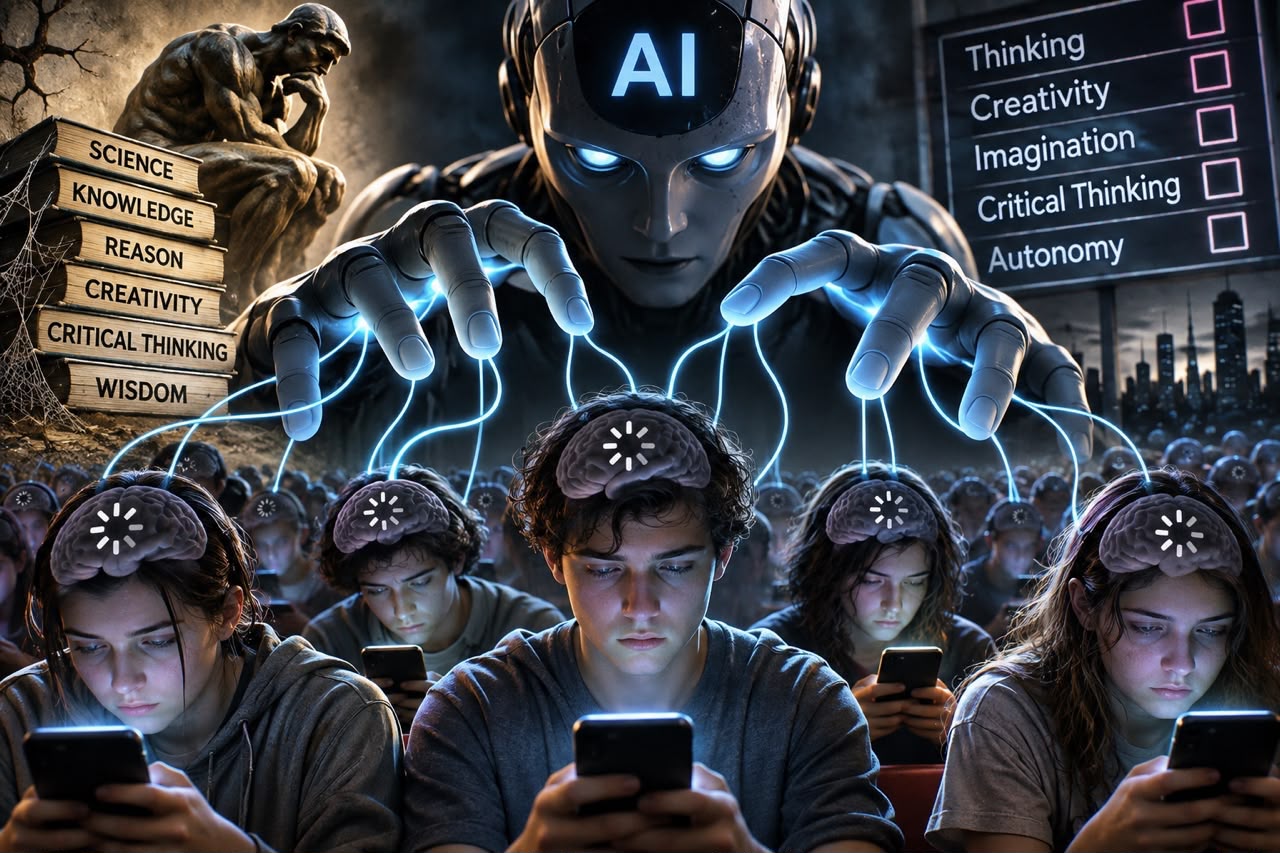
The extraordinarily rapid and seemingly unrestrained advancement of Artificial Intelligence (AI) has become a source of growing concern for me. I know that I am far from alone in experiencing this profound unease. Above all, I find myself wondering what the future holds for younger generations in a world where technology can already solve complex problems, perform sophisticated intellectual tasks, and generate answers across virtually every field of knowledge and professional activity in a matter of seconds.
Yet there is a far deeper and more troubling question, one that I find myself asking almost every day: What will become of our human capacity to think, question, create, imagine, and develop ideas independently? Are we moving toward an era of increasing intellectual dependence, in which the demanding processes of reasoning, investigating, interpreting, and constructing knowledge are progressively replaced by the effortless retrieval of ready-made answers? I find this prospect deeply disturbing.
After all, it was human intelligence itself, through its extraordinary powers of observation, abstraction, creativity, and scientific inquiry, that made the development of Artificial Intelligence possible. Would it not be a tragic paradox if one of humanity’s greatest intellectual achievements ultimately contributed to the erosion of the very cognitive abilities that brought it into existence? We are no longer dealing with a simple calculator or a conventional tool designed merely to assist human work. We are confronting increasingly sophisticated computational systems capable of performing, within seconds, intellectual tasks that previously required years of education, research, experience, and scientific maturation.
The danger is that we may be cultivating entire generations increasingly dependent on these systems, progressively less inclined to confront intellectual difficulties, formulate hypotheses, make mistakes, exercise their imagination, and develop independent reasoning. Yet it is precisely through these processes, often slow, demanding, and frustrating, that humanity’s greatest discoveries and most significant advances have emerged. In a certain sense, AI risks becoming the intellectual drug of the twenty-first century: a form of dependence that is silent, seductive, and increasingly legitimized by society. We are already witnessing individuals becoming almost mesmerized by this technology, accepting its outputs as unquestionable truths, with little critical reflection or concern for examining the validity, consistency, or reliability of the information presented to them. Unfortunately, this tendency appears likely to intensify. Are we moving toward a society that is technologically extraordinary yet intellectually impoverished? A civilization with virtually unlimited access to information, but progressively less capable of transforming that information into genuine knowledge, critical judgment, and wisdom?
I am reminded of a widely circulated statement often attributed to Albert Einstein, although there is no reliable historical evidence that he actually made it, expressing the fear that technology might eventually surpass human interaction and produce a generation of intellectually diminished individuals. Regardless of its actual authorship, the underlying warning has rarely seemed more relevant.
My concerns extend particularly to science and the very foundations of knowledge production. There is a genuine risk that we may trivialize the scientific enterprise by confusing the ease of generating texts, equations, computational codes, and analyses with the much deeper intellectual ability to understand physical phenomena, formulate original questions, and produce genuinely new knowledge.
Science is not simply about obtaining answers. It is, above all, about learning how to ask meaningful questions, challenge results, recognize limitations, and develop a profound understanding of the mechanisms governing the natural world. Scientific knowledge cannot be reduced to an intellectual commodity instantaneously manufactured by algorithms. Science requires curiosity, methodological rigor, creativity, critical reasoning, and, perhaps most importantly, intellectual independence.
There is also an ethical and existential dimension to this transformation that I consider absolutely fundamental. Who will establish the boundaries? Who will be held accountable for the consequences of such a profound transformation in education, professional life, human relationships, and the very organization of society? To what extent are we willing to delegate to artificial systems intellectual capacities that lie at the very heart of what it means to be human? As has happened so often throughout history, I fear that only after substantial damage has already been done, with potentially severe and perhaps irreversible consequences, will we begin to engage seriously in discussions about public policies, regulatory frameworks, and effective mechanisms of oversight capable of addressing the effects of technological development driven, to a considerable extent, by economic competition and the relentless pursuit of power.
I am not opposed to scientific and technological progress. Quite the contrary. I have devoted my life to science, education, and the conviction that knowledge is one of humanity’s most powerful instruments of intellectual freedom and emancipation. It is precisely because of this commitment that I believe we must critically examine the direction in which this technological revolution is taking us.
True progress cannot be measured solely by the increasing capacity of machines to accomplish ever more sophisticated tasks. It must also be assessed by our ability, as human beings, to continue thinking, creating, understanding, questioning, and making decisions independently. We cannot simply remain passive, waiting for time to reveal where this transformation will ultimately lead. By the time we fully recognize the magnitude of its consequences, it may already be too late to reverse some of the damage. To me, the emerging scenario is profoundly unsettling and, in several respects, deeply alarming.
Perhaps the greatest danger posed by Artificial Intelligence is not that machines may eventually become more intelligent than human beings, but rather that human beings, increasingly fascinated by the intelligence of machines, may gradually relinquish the exercise of their own intellectual faculties. Should this happen, we will have brought about one of the most extraordinary and troubling paradoxes in human history: the creation of a remarkable technology intended to expand the boundaries of human intelligence, only to discover that our growing dependence on it has progressively weakened what is most precious about our humanity. Say, the freedom and capacity to think for ourselves.