Faculty of Technology - FT | Department of Mechanical Engineering – ENM | Postgraduate Program in Mechanichal Science – PCMEC
Fluid Mechanics of Complex Flows Research Group – Vortex
Laboratory of Microhydrodynamics and Rheology – Micro-Reo | Laboratory of Scientific Computing in Complex Flows – LCEC
Faculty of Technology – FT
Department of Mechanical Engineering – ENM
Postgraduate Program in Mechanichal Science – PCMEC
Laboratory of Microhydrodynamics and Rheology – Micro-Reo
Laboratory of Scientific Computing in Complex Flows – LCEC
Fluid Mechanics of Complex Flows Research Group – Vortex
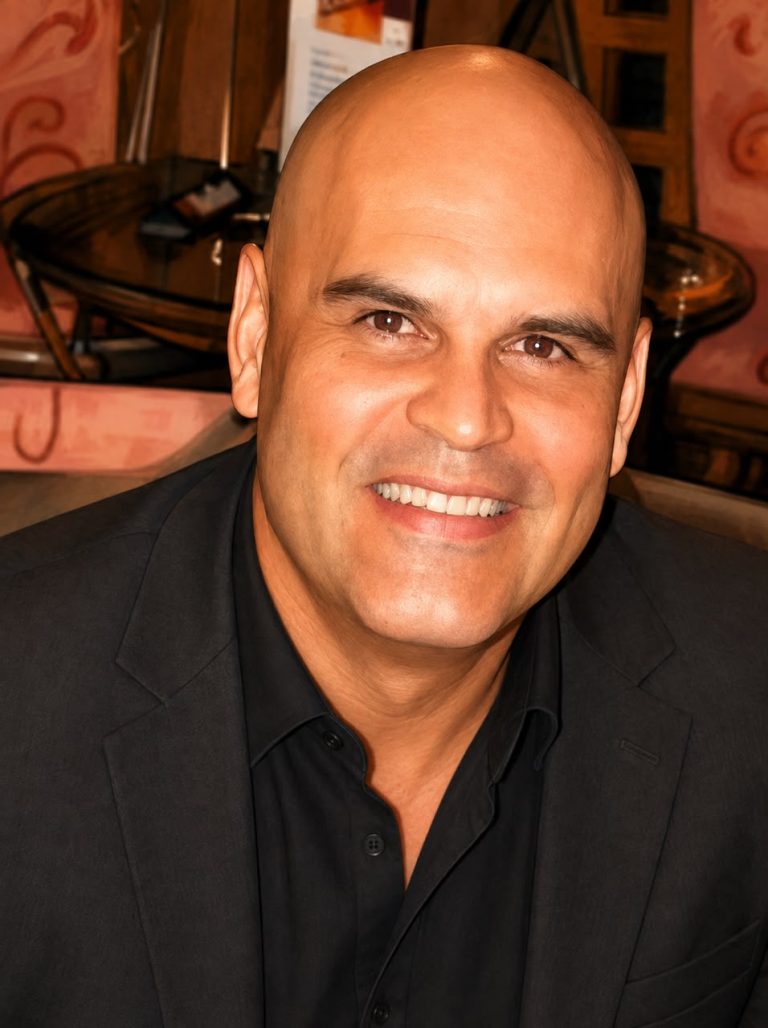
Professor Francisco Ricardo Cunha
BSc., MSc., Ph.D
BSc and MSc (University of Brasília – Brazil),
Ph.D: Department of Appl. Math. & Theoretical Physics-DAMTP-University of Cambridge – UK
Postdoctoral : Yale University – USA and University of California in Santa Barbara – UCSB-USA
ORCID ID: 0000-0003-2882-8195 – Scopus ID: 7102047382 – Lattes-CNPq – Google Scholar
- Leader of the VORTEX – Fluid Mechanics of Complex Flows Research Group/CNPq
- Coordinator of Microhydrodynamics & Rheology LAB – Micro-Rheo/Vortex/ENM/FT/UnB
- Researcher of the National Council for Scientific and Tech. Development – CNPq since 1996-current.
- New Research Productivity Grant – PQ/CNPq – 2025 to 2029
- Past Editor-in-Chief of the J. of the Braz. Soc. of Mech. Sci. and Engn – JBMSE-Springer – 2015-2019
- Current honorary Member of the Advisory Board of JBMSE-ABCM/Springer
Address
University of Brasília – Department of Mechanical Engineering – FT
Postgraduate Program in Mechanical Science – PCMEC/ENM (Capes evaluation – score of 7,0)
Fluid Mechanics of Complex Flows – Research Group – VORTEX
Campus Universitário – Asa Norte, Brasília-DF, BRAZIL, 70910-900
e-mail.: frcunha@unb.br
Courses in the Current Semester UnB – 2/2026
Link: Undergraduate Course: Fluid Mechanics II-ENM
Link: Graduate Course: Non-Newtonian Fluid Dynamics
To Whom It May Concern
The Fluid Mechanics Area at ENM/FT–UnB (1998–present) invites applications from prospective students interested in pursuing a Master’s or Doctoral degree in Complex Fluid Flows within the VORTEX Group, part of the Mechanical Sciences Program (PCMEC). We welcome you to learn more about our research activities, academic environment, and the set of courses developed, formalized, and taught by our group. These include:
(i) Continuum Mechanics
(ii) Fluid Dynamics
(iii) Perturbation Methods in Fluid Mechanics
(iv) Microhydrodynamics
(v) Multiphase Flow
(vi) Non-Newtonian Fluid Dynamics
(vii) Hydrodynamics of Magnetic Fluids (FHD)
(viii) Magnetohydrodynamics (MHD)
(ix) Advanced Topics in Fluid Dynamics
(x) Experimental Fluid Mechanics
We look forward to welcoming motivated students to our research group!
RESEARCH
This professor serves as the scientific leader of the Complex Fluid Mechanics Group and the Microhydrodynamics and Rheology Laboratory at the University of Brasília. His research focuses on the rheology of complex fluids, the hydrodynamics of magnetic fluids, non-Newtonian fluid dynamics, and the microhydrodynamics of active and passive particles in suspension, as well as the mechanics of mobile suspensions more broadly. His work is inherently interdisciplinary, integrating fundamental theory, advanced computational modeling, and experimental investigations to address contemporary challenges in complex fluid flows.
A real magnetic emulsion composed of ferrofluid microdroplets (volume fraction = 1%) is considered. Upon the application of an external magnetic field, the fluid exhibits strong anisotropy already at t=0, leading to the formation of elongated chain-like structures. This system therefore represents a highly complex fluid. (M.F.S. Aleixo Filho & F.R. Cunha, 2026)
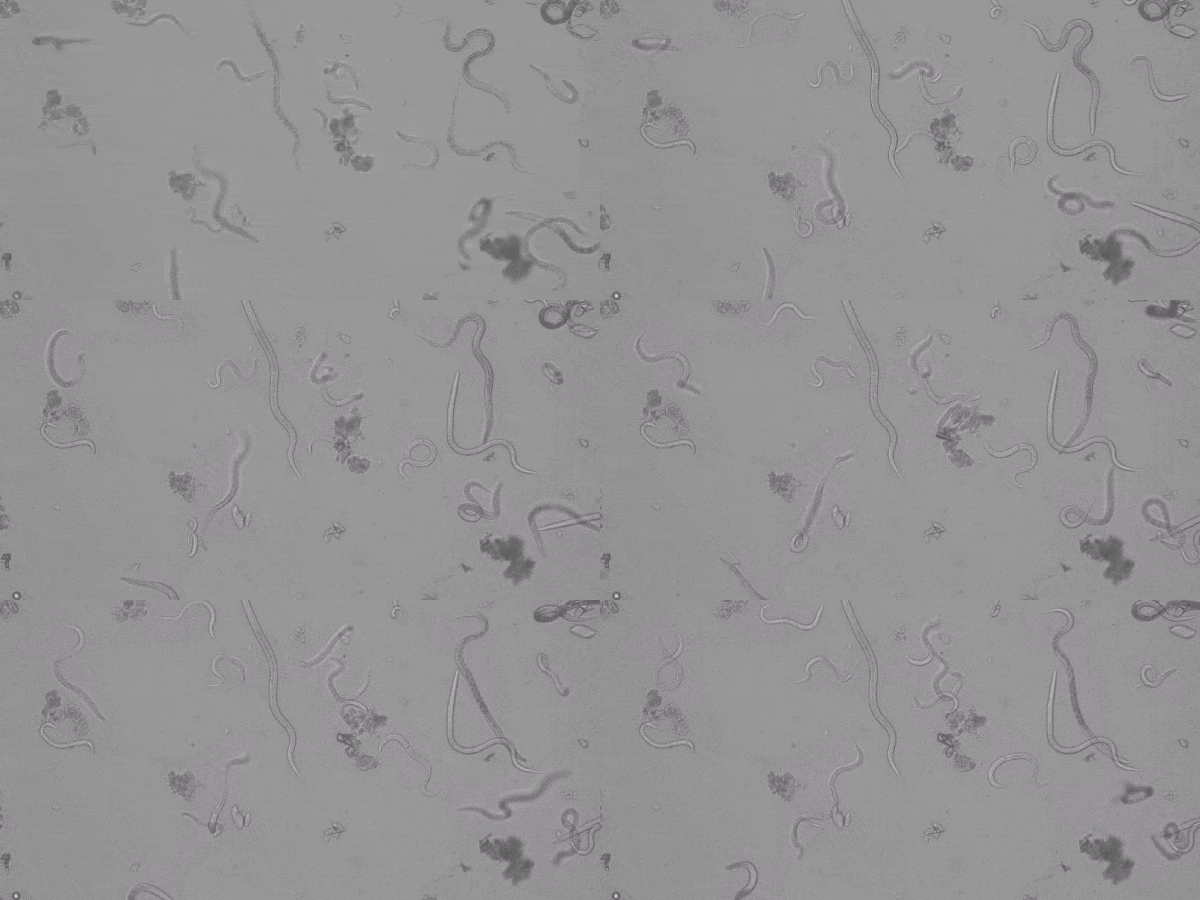
We experimentally investigate the collective swimming behavior of Caenorhabditis elegans nematodes in viscoelastic media, focusing on bulk-averaged locomotion dynamics obtained from ensembles of approximately 100 individuals across multiple realizations. The study examines the hydrodynamic interactions among nematodes suspended in an agar-based viscoelastic fluid, considering different volume fractions of both the living organisms and the macromolecular constituents of the surrounding medium. The analysis includes the characterization of nematode size distributions, average beating frequencies, and the wavelengths of the traveling muscular waves that propagate along their slender cylindrical bodies. In addition, we determine the mean body curvature and the average propulsion velocity of populations of small nematodes, with body lengths ranging from approximately 100 to 500 μm, under low-Reynolds-number and high-Péclet-number conditions. The body-nematodes bending (muscular waves) effect on its self-propulsion is also observed and characterized. Scaling arguments based on balances of viscous, bending and elastic forces are also explored in this research. The rheology of the active suspension undergoing oscillatory shear of small and moderate amplitudes is largely explored regarding the viscous and elastic effects of the active particle collective motion. This video was produced at the Laboratory of Microhydrodynamics and Rheology of the Vortex Group, University of Brasília (Brazil). Related studies can be found in S. Malvar and F.R. Cunha, Physics of Fluids (2021), Rheologica Acta (2019), and Biomicrofluidics (2017), . The C. elegans nematodes used in this study were kindly provided by C. E. Winter (Department of Parasitology, University of São Paulo, Brazil). Y. G. Irilan & F. R. Cunha – Physics of Fluid, 2022.
VORTEX News

On the Limits of Contemporary Academic Evaluation Models: The Obsession with Indexes and Metrics (by F. R. Cunha – ENM/FT/UnB)
Contemporary academic evaluation models often focus heavily on indexes and metrics to assess research quality and impact. This reliance has created a system where numerical
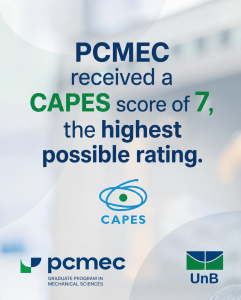
PCMEC was awarded the highest CAPES rating (Grade 7)
Our Graduate Program in Mechanical Sciences (PCMEC) achieved a score of 7.0 in the CAPES evaluation for the 2020–2024 period, a maximum rating that attests